I would not believe it if I did not read it myself. In the July issue of Ukraine's leading newspaper Pravda,
former first lady, Kateryna Yushchenko, quotes Mises, Hayek and ... my dissertation advisor, Professor Peter J. Boettke. Mrs. Yushchenko wrote her op-ed about free market debate in Ukraine. She makes excellent points.
Here is a link to the original and here is a link to the Google translation. Since the Google translation is not perfect, I just want to clarify it. Mrs. Yushchenko quotes Dr. Boettke drawing analogy of the heavily regulated market economy with the Olympic swimmer in shackles. She quotes Professor Boettke saying that "if you put shackles on legs and hands of the Olympic swimmer, wrap heavy chain around him, and drop him in the swimming pool, he will drown. But you still can't say that he can't swim." Neither you can say about the heavily regulated market economy that free market does not work. Really great op-ed!
Showing posts with label Viktor Yushchenko. Show all posts
Showing posts with label Viktor Yushchenko. Show all posts
October 19, 2010


October 4, 2010
A Farewell to Democracy, Free Media, and Free Enterprise: Ukraine's Prospects Revised
In my old post I wondered whether Ukraine had a strong political opposition to counteract advances of President Yanukovich against democracy, economic freedon, and free media. My answer was yes. And I was too optimistic. I thought that either former prime minister Yulia Tymoshenko or former president Viktor Yushchenko could stop the Yanukovich machine. They failed again. Everyone left Tymoshenko. Her former sponsors and party members are in the Yanukovich team now, not always voluntarily. Yushchenko is a political ghost. Nobody can stop President Yanukovich and his Party of Regions, at least, in Ukraine. The Yanukovich administration did more in six months than the Kuchma administration in ten years. The Yanukovich administration curbed media freedom, oppressed small-scale and medium-size business, and installed dictatorship.
A farewell to freedom of speech. The Yanukovich administration curbed freedom of media really fast. Ukraine's mass media looks like Russian media now. Nobody criticizes President Yanukovich openly. It got to the point that the Voice of America can lose its broadcasting partners in Ukraine very soon as it happened in Russia.
A farewell to free enterprise. The Yanukovich administration hammered small-scale and medium-size businesses with oppressive tax policy. The new tax code promises to become the apocalypse of economic freedom in Ukraine. All small-scale and medium-size businesses move their operations to the shadow economy before the new tax code will go in effect.
Finally, a farewell to democracy! The Yanukovich administration won the case vs the 2004 Constitutional Amendment in the Constitutional Court of Ukraine. The 2004 Amendment was very important step in Ukraine's democratization. It was once in a lifetime opportunity. In brief, this amendment separates powers between president and prime-minister where the former is responsible for foreign policy and the latter takes on duties of domestic policy. Not anymore! The executive power is centralized now! The Constitutional Court ruled last Friday that the 2004 amendment violated the Constitution of Ukraine and thus the Constitutional Court overruled it. Did I mention that right before the seminal ruling four judges of the Constitutional Court were replaced with four new judges affiliated with the Party of Regions.
So, Ukrainians, please, say a farewell to democracy for the next five years at least. But it's no the saddest part. It's really sad that if Yulia Tymoshenko won the presidency, she would do the same. The only difference is that the Party of Regions could stop her. Who is going to stop the Yanukovich machine?
A farewell to freedom of speech. The Yanukovich administration curbed freedom of media really fast. Ukraine's mass media looks like Russian media now. Nobody criticizes President Yanukovich openly. It got to the point that the Voice of America can lose its broadcasting partners in Ukraine very soon as it happened in Russia.
A farewell to free enterprise. The Yanukovich administration hammered small-scale and medium-size businesses with oppressive tax policy. The new tax code promises to become the apocalypse of economic freedom in Ukraine. All small-scale and medium-size businesses move their operations to the shadow economy before the new tax code will go in effect.
Finally, a farewell to democracy! The Yanukovich administration won the case vs the 2004 Constitutional Amendment in the Constitutional Court of Ukraine. The 2004 Amendment was very important step in Ukraine's democratization. It was once in a lifetime opportunity. In brief, this amendment separates powers between president and prime-minister where the former is responsible for foreign policy and the latter takes on duties of domestic policy. Not anymore! The executive power is centralized now! The Constitutional Court ruled last Friday that the 2004 amendment violated the Constitution of Ukraine and thus the Constitutional Court overruled it. Did I mention that right before the seminal ruling four judges of the Constitutional Court were replaced with four new judges affiliated with the Party of Regions.
So, Ukrainians, please, say a farewell to democracy for the next five years at least. But it's no the saddest part. It's really sad that if Yulia Tymoshenko won the presidency, she would do the same. The only difference is that the Party of Regions could stop her. Who is going to stop the Yanukovich machine?
May 30, 2010
Ukraine’s Prospects
I am reading couple books – Economic Analysis of Property Rights  by Yoram Barzel and Free Market Environmentalism
  by Terry Anderson and Donald Leal. These books are not about Ukraine. But these books have great insights that can be applied to Ukraine. So here is what I am thinking.
by Yoram Barzel and Free Market Environmentalism by Terry Anderson and Donald Leal. These books are not about Ukraine. But these books have great insights that can be applied to Ukraine. So here is what I am thinking. Human values matter only for human decisions. Human beings always respond to incentives. Price provides the strongest incentive since money matter a lot for most people. Price sends a correct signal only in a free market and democratic society. Otherwise, a price signal comes with a white noise - a market distortion (e.g. central planning in the former Soviet Union). Then everything goes wrong. Free market economy needs democracy as much as a democracy needs market economy. Without a free expression of a political will, a dictator can destroy an unfettered faith in a free market process. Without a faith in a free market, people will not respect market prices and property rights. Without a free market, a democratic society can't use its resources efficiently because the social decisions are not based on the market prices. The final element is a rule of law. Without a rule of law, a democratic nation with a free market economy will always operate at a suboptimal level because a cornerstone of a free market society – private property – is not protected by the law. Thus, a nation can prosper only if three elements are in place. Otherwise, a nation is doomed to be an underachiever.
So where is Ukraine now? Ukraine has two elements in place – an emerging free market economy and a consolidating democracy. The rule of law is a weak link in Ukraine's path of post-socialist development. A recently elected Ukraine's president – Mr. Yanukovich - is more likely to follow the Putin's Russia style of command and control  rather than a very hands-off approach of his predecessor – Mr.Yushchenko
 . It's a no-brainer to predict Ukraine's path of development under Mr. Yanukovich. His team will curb media freedom, redistribute state property through privatization to his donors, increase a tax burden on private sector except friendly corporations, and cater specifically to the Russian interests. Does Ukraine have a strong political opposition to offset any potential damage to be made by Mr. Yanukovich. Yes. At least, three politicians can resist Yanukovich's advancement against democracy and free market. It will be former prime minister Yulia Tymoshenko, former president Viktor Yushchenko, and former parliamentary speaker Arsenyi Yatseniuk. I guess that we will see really soon whether the Ukrainian trinity can work effectively from the barricades of the parliamentary opposition.
rather than a very hands-off approach of his predecessor – Mr.Yushchenko. It's a no-brainer to predict Ukraine's path of development under Mr. Yanukovich. His team will curb media freedom, redistribute state property through privatization to his donors, increase a tax burden on private sector except friendly corporations, and cater specifically to the Russian interests. Does Ukraine have a strong political opposition to offset any potential damage to be made by Mr. Yanukovich. Yes. At least, three politicians can resist Yanukovich's advancement against democracy and free market. It will be former prime minister Yulia Tymoshenko, former president Viktor Yushchenko, and former parliamentary speaker Arsenyi Yatseniuk. I guess that we will see really soon whether the Ukrainian trinity can work effectively from the barricades of the parliamentary opposition.February 5, 2010
The 2010 Presidential Election in Ukraine: It’s a Final Countdown
I really love this 80's rock song. Yeah, it's the final countdown for the 2010 Presidential Election in Ukraine. This Sunday Ukrainian voters will chose their next president. Will it be an odious former PM Viktor Yanukovich who was officially backed by the Kremlin in 2004 and tarnished his political reputation by using his de jure political power to rig the 2004 presidential election? Btw, the law suit against Mr. Yanukovich never made it to the Supreme Courte. Will it be another nevertheless odious incumbent PM Yulia Tymoshenko who drove Ukraine's economy to the brink of collapse by using command-control approach and choking individual economic freedom? Btw, the Kremlin considers Mrs. Tymoshenko the second BFF (after Mr. Yanukovich) since she can take all credits for the recent gas deal between Russia's state-owned Gazprom and Ukraine. According to the newly signed gas contract, among all European countries, Ukraine will pay the highest price for the Russian gas.
 |
| From UkraineWatch |
Anyways, whoever wins this election should make it in a true democratic process! Nobody wants to repeat the Orange Revolution. Moreover, Ukrainians are not really psyched about the upcoming 2nd round because very few voters can tell a difference between candidate Y and candidate T. Honestly, what's the difference? Mr. Yanukovich never disguised his pro-Russian political and economic preferences. PM Yulia Tymoshenko's economic policy did not leave much of a choice for Ukrainian business. At the present moment, Ukraine has the largest number of international trade restrictions. Russia does not really care about it because the Kremlin still apathetically negotiates its WTO membership. I am surprised that the WTO has not addressed the Ukrainian situation yet. Well, it's understandable because the Sino-US trade war is much more fun to watch. Plus, the global economic crisis is not over yet. And some countries kind of overreacted with their own trade policies. All this together keeps WTO busy.
Honestly, the previous presidential elections were much more interesting because there was always something at stake (see figures below). The 1991 presidential election was important in terms of state-building. The newly independent state needed a democratic leader such as Mr. Leonid Kravchuk (1991-1994). However, the incumbent president Kravchuk catered more to the nationalist constituency in the Western Ukraine so that the 1994 presidential election allowed the Eastern Ukraine to bring pro-Russian technocrat, Mr. Leonid Kuchma, to the power.
 |
| From UkraineWatch |
The 1994 presidential election played a seminal role in the emergence of the region-based division among Ukrainian voters. In 1994 it became clear that the Western provinces held a strong preference for nationalist pro-Western politics, while the Eastern and Southern provinces strongly supported technocratic pro-Russian politics. Another interesting observation was that the Central provinces turned out to become the potential swing constituencies.
The 1999 presidential election also spiced up the Ukrainian politics. That year the Ukrainian voters had to make a crucial choice between two antagonistically ideological candidates: a left-wing pro-Russian Mr. Petro Symonenko, a leader of the Communist Party, and a right-wing incumbent president Kuchma (1994-2004) who learned to balance out his foreign policy between both EU and Russia. The leader of the Communist Party failed to capitalize on nostalgic political preferences of the Soviet-generation constituency. By receiving only 37.8% of votes, Mr. Symonenko succeeded in swinging only several Central and couple Southern provinces. In the meanwhile, most of the former Kravchuk constituency located in the Western provinces and the stronghold pro-Kuchma constituency in the Eastern provinces came united against the ghost of the communism. Since then the left-wing politicians witnessed a tremendous drop in their popularity. The communist front-runner Petro Symonenko received only 4.97% and 3.54% of votes in the 2004 and 2010 presidential elections, correspondingly.
Then Ukraine had the Orange Revolution in 2004. The 2004 presidential election will always be a historical landmark of Ukraine's state-building. After all calamities surrounding rigged 2nd round and its rerun in the late December, a nationalist liberal pro-Western candidate and former PM Viktor Yuschchenko won the election with 51.99% of votes. Once again the same swing Central provinces gave Mr. Yushchenko so needed handicap. The incumbent PM Viktor Yanukovich lost not only election but also his PM position. Furthermore, the authoritarian glitch in the Kuchma administration tarnished former PM's political reputation significantly. While Mr. Yanukovich received 44.25% of votes in 2004, his popularity dropped to 35.3% votes in the 1st round of the 2010 presidential election. Nonetheless, Mr. Yanukovich received a ten-percent lead over the incumbent PM Tymoshenko. The incumbent president Yushchenko (2005-2010) who became ultra-nationalist closer to the end of his term received only 5.45% of votes. It's actually very interesting fact about the 2010 presidential election that for the first time in the recent political history of Ukraine the incumbent president did not make it to the 2nd round. On the other hand, the 2nd round offers Ukrainian voters a cliché choice between two PMs: the former and the incumbent. Once again, what's the difference?
 |
| From UkraineWatch |
Nonetheless, I am sure that the final results of the 2010 presidential election will give us more fodder for further discussion of Ukraine's political institutional development. The key to a victory in the 2nd round of this presidential election is a candidate's ability to capitalize on constituencies in the swing Central and Southern provinces. But I guess it's too late to give this piece of advice, ha!
 |
| From UkraineWatch |
 |
| From UkraineWatch |
January 14, 2010
Assorted Links: 2010 Ukraine’s Presidential Election
- Ukraine's Presidential Election goes Twitter! If you are really interested in following Ukraine's Presidential Elections on Twitter, here is a site: http://www.electua.org/. However, I should warn you that most twits are in either Russian or Ukrainian.
- The Jamestown Foundation Blog has a very interesting post about the supposedly rising popularity of the technical presidential candidate, Mr. Tihipko. Tammy Lynch asks the following question: "Can Tihipko Spoil Tymoshenko's First-Round Party?". My answer is "NO" unless all reputable public opinion surveys had a really awful margin of error.
- Wikipedia has a page devoted to the 2010 Ukraine's Presidential Election. This page has a nice summary table that demonstrates a change in public support of main presidential candidates. Btw, I've never heard about the Research and Branding Group before. Have you? But it seems to be a very popular research organization in this particular table.
January 6, 2010
Orange Forever!
I've received a letter from Bishop Paul Peter Jesep, U.S. Spokesperson for His Beatitude Metropolitan Myfodii of Kyiv and All Ukraine, from Ukrainian Autocephalous Orthodox Church Kyiv-Patriarchate. With his permission, I post it here. It's a very interesting reflection on political beliefs in the American-Ukrainian community:
"Ukraine's Orange Revolution lives! The country's cultural and spiritual reawakening shows that requiems and obituaries are premature. President Viktor Yushchenko has been criticized for his political and economic stewardship. Some of it justified. Although not yet recognized, his legacy is positive and significant. He is the first Ukrainian president who embraced and encouraged the country's distinct Eastern Slav consciousness. Yushchenko challenged his countrymen, Jew, Muslim, Christian, and non-believer to ask who they were as one Ukrainian nation. He reached out to Jews and Muslims as no leader has before to underscore their contributions to Ukraine. Ultimately, a country's soul is defined by its artists, writers, composers, and the language its people speak. Although unable to show a deft touch in educating those who identified with Russian culture in eastern Ukraine or the Crimea, Yushchenko nurtured a national reawakening. He did so, in part, at the expense of bread and butter issues during a worldwide recession.
Yushchenko showed no sympathy in dealing with Russia's national identity crisis. What does it mean to be Russian without Kyiv, the Mother of All Russian cities? His indifference fueled Moscow's ongoing efforts to marginalize Ukrainian culture, language, and history in the international media. According to Russian President Vladimir Putin, Ukraine is nothing more than a breakaway province. He incorrectly insists that it never existed as a nation prior to the breakup of the Soviet Union. Ukraine has a thousand year history. Its final incorporation into Russia occurred when Empress Catherine finally defeated the libertarian, free-spirited Ukrainian kozak state with its rudimentary democratic structure. Spiritually, there can be no Russia without Kyiv. Culturally, politically, and intellectually Moscow cannot let go of Ukraine because to do so leaves its own national identity in question. The Eastern Slavic soul beats in Kyiv, not Moscow, Novgorod, St. Petersburg, or anywhere else in Russia or Belorussia.
It's ironic that Viktor Yanukovych, the Moscow supported presidential candidate from eastern Ukraine, recently told the Associated Press that "the development of . . . democratic principle in our country" was a "price . . . too great." Yet Yanukovych benefits from the very freedom he criticizes in his campaign. During the Associated Press interview Yanukovych also mocked the Ukrainian language as "gibberish" and the messiness of democracy as a "variety show." He vows commitment to a Leninist "rule of law" and the restoration of the Russian language to its superior place.
Regardless of who is the country's president, the sky is blue if Ukrainians in the country and those in the Diaspora work to cultivate the Ukrainian language. If young artists, writers, dancers, musicians, composers, and Christian and non-Christian spiritual leaders in Ukraine nurture the Ukrainian-Eastern Slav soul then the wheat fields are golden. President Yushchenko opened the door. Complacency will shut it. The Orange Revolution is not about personalities. It is about ideas, values, and principles. It's about the culture of a people. Ukrainians are the only Eastern Slav people with the courage to wrestle with the challenges of democracy. Democracy is not about convenience. It is about liberty.
The Orange Revolution can and will live on so long as patriots and those in the Diaspora recognize the critical importance of promoting Ukrainian art, culture, language, and literature. It will not matter who is president so long as ordinary Ukrainians in Ukraine and the Diaspora work to nurture, preserve, and further the country's distinct heritage."
December 17, 2009
Ukraine’s Government Begs the IMF for Help
The IMF gave Ukraine $16.4 billion in the beginning of 2009. But Ukraine got only $11 billion before the IMF got fed up with a political mess in the Ukrainian parliament and government spending unleashed by the Tymoshenko government. President Yushchenko made things worse when he sent the Minimum Wage Bill to the floor of Ukraine's parliament. However, Ukraine's president can only propose a bill while its destiny solely depends on a will of a whimsy parliament. Of course, the minimum wage bill got stock in the parliament because the Tymoshenko government directed all its attention to fighting the phantom outbreak of swine flu in Ukraine. Now we all know what kind of outbreak it was (see previous posts).
This week the Tymoshenko government sent its representatives, including two Deputy Ministers of Finance, Ihor Umanskiy and Anatoliy Myarkovsiy, to the IMF in Washington, D.C., USA. Now Ukraine's government asks just for two billion dollars from the rest of the frozen IMF loan. I have a very obvious question: What for? The government received $11 billion earlier this year and where did it go? Ukraine's president Viktor Yushchenko asks prime-minister Yulia Tymoshenko the same question. The Ukrainian economy still experiences the deepest recession among other FSU countries. What's going on with the government accountability in Ukraine? In the meantime, a date of the first round of the 2010 Presidential election is approaching.
November 26, 2009
Face Mask and Price Control: Ukraine’s Government Fights off H1N1 Virus
Over the last two weeks, Ukraine's Prime Minister Tymoshenko provided a classic example about when price controls and government misinformation could go awry. The government spread panic among Ukrainians by announcing that the country had an outbreak of swine flu in the Western regions. It stated that soon enough the whole nation would be infected with the epidemic and deadly swine flu. In all major TV channels, prime minister told the nation that "the world sent the second greatest trial, after the global financial crisis, to Ukraine and that the nation was not ready to cope with the new disaster". Even Ukraine's president Yushchenko who usually avoids populist decisions wobbled under political pressure and asked for emergency financial and medical aid from the European Union and other countries. In another televised address to the nation, the prime minister announced a three-week recess in schools and universities. The government also banned any public gatherings during the same time period.
 |
| From UkraineWatch |
Can you guess what happened next to a demand for all medical supplies that could somehow help to fight off the imminent virus? The demand for medicals supplies simply skyrocketed. Shelves of local pharmacies were emptied within two days. Ukrainians bought everything starting from face masks to herbal supplements to flu medications. The price of face masks went up three times across the country until it became impossible to find it in the stores. Some small-scale apparel producers quickly added a new production line to meet the surge in demand. Several boutique stores even tried to add chick to the dismal face masks by putting funky designs on them including a happy face. The government officials, that caused the panic in the market in the first place, responded with an old-school approach by imposing price controls on all necessary medical supplies and face masks. Ukraine's government even went further by threatening entrepreneurs with arrests if they try to make an extra buck on the "swine flu panic". The Leviathan of the Ukrainian government was unleashed. All imaginable regulatory agencies ranging from anti-trust agents to fire-control inspectors swamped local pharmacies and markets to enforce this crazy edict. Subsequently, many privately-owned pharmacies cut down their working hours and even shut down in order to avoid conflict with ravaging regulatory agencies. Even black-market entrepreneurs scaled down their operations to avoid any interaction with law enforcement. Could you guess what happened next? The anti-market behavior of the Ukrainian government proved the law of unintended consequences once again when all medical supplies vanished almost overnight.
Unfortunately, the story does not end there. When fidgety consumers faced the empty shelves in the pharmacies, they retreated to all kinds of substitute goods. Traditional Ukrainian medicine prescribes garlic, onion, and lemon to combat the cold. The demand for these goods rose and their prices doubled. In Kharkiv, the second largest city of Ukraine, the price of garlic skyrocketed from 5 hryvnia per bundle to 55 hryvnia (approximately, 7 USD). The government stepped in again. The government accused retailers of making windfall profits on the virus outbreak. However, a public outrage spurred by several public whistleblowers such as Ukraine's celebrity doctor Dr. Komarovksy made the government back away from another price control. The World Health Organization made an official statement saying that Ukraine did not have a very serious H1N1 outbreak. The government rushed to announce that its "quarantine measures" prevented the outbreak of swine flu. Indeed, everything seems to be back to normal though it is still hard to find lemons in the grocery stores. Many Ukrainians also wonder what they should do with the surplus of home medical supplies. Everyone seems to realize the government caused the panic in the markets in the first place by misinformation, and then they try to correct the markets by using anti-market policy instruments. And you know what happened.
Thus, after two decades of post-socialist development Ukraine's government seems to misunderstand its role in a market economy. Sequences of policy lapses like these represent the importance of understanding basic economics, the law of unintended consequences, and resisting populist pressures. Otherwise, the government hurts its own people instead of protecting them.
November 12, 2009
Swine Flu Infects Ukraine’s Politics
It's been in the news since last week that Ukraine has an outbreak of swine flu aka H1N1. Russia, Poland and other neighboring countries overreacted by limiting entrance of Ukrainians across borders. Ukrainian politicians overreacted even more than their foreign peers. Whether the outbreak of swine flu had place, the whole governance system simply folded under exigent circumstances as a house of cards touched by a slight breeze. Politicians did everything what they should not do. Instead of protecting its citizens, the Ukrainian government spread panic and fear among the public.
 |
| From UkraineWatch |
First, it is very interesting that the government was solely responsible for a panic among the public. The Ukrainian government misinformed citizens about H1N1 outbreak. The World Health Organization says that there was no outbreak of swine flu in Ukraine. The government spread a panic among population when Prime Minister Tymoshenko and the Health Minister announced that Ukraine's Ministry of Health registered a record number of people infected with swine flu somewhere in Western Ukraine. However, the World Health Organization has not confirmed an outbreak of swine flu in Ukraine yet! Moreover, a number of deaths from pneumonia that is a complication of seasonal flu was very far from a critical level. Since "the outbreak of H1N1 flu" (October 29, 2009) Ukraine that is a nation with 46 million people has lost 213 people from pneumonia. Only six cases of the H1N1 infection were confirmed. Several medical doctors have already criticized the Tymoshenko government for misinterpreting data and misinforming the public. The most adamant critic of the government incompetence is Dr. Komarovsky who went on several TV shows to calm down Ukrainians and dissolve a myth about the H1N1 outbreak. The government has already changed its position on the epidemic H1N1 situation by announcing that its preventive measures have already reduced the number of flue infections at least by a factor of four.
Second, instead of H1N1 outbreak, we witnessed, perhaps, a final break in the Orange coalition. When Ukraine's president Yushchenko rushed to ask for medical supplies from Europe in order to fight the nonexistent epidemic swine flu, Ukraine's prime minister Tymoshenko ridiculed him for relying on foreign aid instead of doing something himself. Mrs. Tymoshenko promised Ukrainians that she would provide masks for free at each mobile office of her party across country. President Yushchenko retaliated by filing a law suit to the Supreme Court against the Tymoshenko government for failing to report data on a spread of seasonal flu and holding public rallies during "the outbreak of H1N1 virus".
Third, Mrs. Tymoshenko blatantly used "a fight with swine flu" for the sake of her presidential campaign. She proclaimed a fight with swine flu "the second great trial given by the world to Ukraine after the world financial crisis". She made it clear that H1N1 "outbreak" is her number 1 priority in the ongoing presidential campaign. Mrs. Tymoshenko went to war with the swine flu with such zeal and vigor as Miguel de Cervantes' heroic knight Don Quixote who rode his horse to fight windmills. I guess the WHO officials were really touched by the brave heart of Mrs. Tymoshenko that they reconsidered the status of H1N1 in Ukraine to "assumed outbreak". WOW! Well, it's hard to blame the WHO for still being shy when only six person died with a confirmed H1N1 virus from 250,000 "assumed" infected in a country with 46 million people. I am not a doctor, but it doesn't even look to me as a potential outbreak.
Why and what happened to Ukraine's government? I don't really know. But "H1N1 outbreak" shows once again a "professionalism" of Ukrainian politicians. The "outbreak" also demonstrates that what government can do when it is a group of incompetent self-interested individuals delegated with executive and legislative power and driven by the electoral campaign. This kind of government can't do anything good!
October 18, 2009
It’s a Final Countdown
For the fourth time in its history, Ukraine will have the presidential election. It will be less than in 90 days. The main competition will be between both pro-Russian politicians: prime-minister Tymoshenko and POR's front-runner Yanukovich. The Central Election Committee of Ukraine estimates that the government will have to spend at least $160 million on the elections. A registration fee for each presidential candidate is $314k.
According to the most recent public opinion poll SOCIS, the most popular presidential candidates are 59-yo Viktor Yanukovich (28.7%), 48-yo Yulia Tymoshenko (19%), and 35-yo Arsenyi Yatseniuk (8%). Ukraine's president Viktor Yushchenko enjoys only half of public support of another Orange Revolutionary, Yulia Tymoshenko. In terms of political ideology, Mrs. Tymoshenko represents the left-wing of Ukrainian politics, while Mr. Yanukovich poses himself as the right-wing and Mr. Yatseniuk is in the center. If we use analogy with the American politics, Ukraine's prime-minister is a socialist democrat where Mr. Yanukovich is a republican and Mr. Yatseniuk is independent.
October 12, 2009
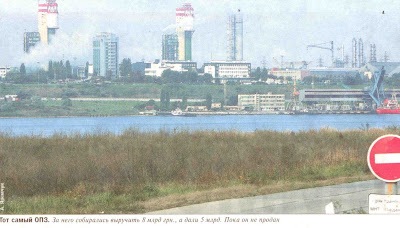
Odessa Chemical Plant's Privatization: To Be or Not To Be?
Ukraine's State Property Fund (henceforth, SPFU) fails to sell the Odessa Chemical Plant that is a monopolist in Ukraine's chemical industry. Moreover, Odessa Chemical Plant is the largest producer of ammonium nitrate in Eastern Europe.
Here are the events behind the failed sale. First, the privatization was mission impossible from the start because it was outlawed by Ukraine's President Viktor Yushchenko. Presidential Decree #200:2007 prohibited a privatization of the Odessa Chemical Plant because it held strategically important position in Ukraine's market for chemical products. Nonetheless, prime-minister Tymoshenko and SPFU persuaded bidders and public that it could overrule the presidential ban on privatization. Then the ban should be overruled before the start of auction, right?
Anyways, several bidders decided to participate in the auction and paid upfront 400 million hryvnia ($50 mln) in auction fees. One of the bidders was GAZPROM-owned Azot-Service Company. The auction was broadcasted on several national TV channels. SPFU offered a starting bid of 4 billion hryvnia while all experts including SPFU agreed that the real market value of the Odessa Chemical Plant was at least 8 billion hryvnia ($1 bil). Then Ukraine's Nortima Company that is a part of a Dnepropetrovsk-based corporation Privat offered the winning bid of 5 billion hryvnia. Privat's CEO Ihor Kolomyisky said that he was ready to offer up to $1 billion. Little did he know that SPFU would refuse to recognize the legitimacy of the auction? SPFU's official statement is that the winning bid was much lower than the real market value of the auctioned item. So the deal is off.
It's hard to understand the true nature of all commotion around the Odessa Chemical Plant. Prime-minister Tymoshenko who makes a rule of law as a cornerstone concept of her presidential campaign does not really show a lot of respect for the rule of law. It's also not clear why president Yushchenko refuses to auction off the Odessa Chemical Plant that he was very eager to sell three years ago. Perhaps, the failed privatization best illustrates only the Tullock rectangle.
From UkraineWatch
September 22, 2009
The Post-American Ukraine
This week shows that USA gives up on Ukraine. NATO gives up on Ukraine as well. The Obama administration decided to abandon a controversial missile-defense system that the Bush administration planned to build in the Czech Republic and Poland. The infamous air-defense system always rattled Mr. Putin and Mr. Medvedev. Now they can sleep well. No defense system in Eastern Europe, no threat to Russia. But can Ukraine sleep well now? No. Ukrainian politicians just woke up in a new world to them – the post-American Ukraine. Since Ukraine's breakaway from the former Soviet Union a main objective of the Ukrainian foreign policy was to distance itself from Russia and get closer to Europe. Not anymore! Nobody needs Ukrainian democracy in EU. Nobody welcomes Ukraine to NATO. Whoever will become the next president of Ukraine, he or she will have to come up with a new foreign policy if Russia gives him or her freedom of choice.
Now let's get back to Russia. If Mr. Medvedev believes in a tit-for-tat strategy in his foreign policy, then Russia must express a gratitude to the friendly Obama administration. So what does Russia do? According to the Economist, Hugo Chavez said that Venezuela would buy 92 tanks and a missile system from Russia with a $2.2 billion loan given by Russia. Wait a sec. Russia thanks USA by selling guns to anti-American Venezuela. What does the US do? The United States expresses concern over an arms race in the South America.
What else has Russia recently done? Mr. Medvedev has sent an aggressive and insulting letter to Viktor Yushchenko, Ukraine's president. Russia's district of attorney says that it has enough evidence to prove that several Ukrainians fought on the Georgina side against the Russian troops in the 2008 Russia-Georgia war. Russia's state-owned energy company GAZPROM has already told Ukrainians that they'll have heat and electricity in their homes only if their next president is pro-Russian politician. I am also afraid that Mr. Putin hasn't forgiven his biggest political embarrassment yet. Five year ago the Orange Revolutionaries, Yulia Tymoshenko and Viktor Yushchenko, brushed Mr. Putin off after he rushed prematurely to congratulate Viktor Yanukovich as winner of the rigged presidential election. The upcoming presidential election offers Mr. Putin to get back on both Yushchenko and Tymoshenko. January's presidential election in Ukraine will become the key event in Russia's new political season.
So which presidential candidate does Russia want to see as Ukraine's next president? The first choice must be Viktor Yanukovich. However, president Yushchenko's party OUNS speculates that Mrs. Tymoshenko has already made a deal with Russia.

September 12, 2009
British American Tobacco Will Advise Ukraine’s President on FDI
According to the Presidential Decree #613, President Yushchenko appointed several foreign CEOs to the Presidential Committee on Foreign Direct Investments. Now the FDI committee includes CEOs of several foreign companies such as British-American Tobacco, Siemens AG, ArcellorMittal, Hungary's OTP Bank, and Austria's Raiffeisen Bank. In other words, President Yushchenko's advisers will represent tobacco, steel, electronics, and banking industries. Lakshmi Mittal, a 58-year-old CEO of ArcellorMittal, is the most interesting choice among all new advisers. One, Mr. Mittal is extremely rich. The Forbes places Mr. Mittal with $19.3 billion in net worth on the eighth place in the World's Billionaires List. Two, Mr. Mittal represents British-Indian steel company that is the major rival of Ukraine's steel tycoons such as Rinat Akhmetov and Viktor Pinchuk.
August 26, 2009
The Economist: Dear Viktor, You’re Dead, Love Dmitry
I've already blogged about Russia's President Medvedev's letter to Ukraine's President Yushchenko. But The Economist has a very cool piece about it "Dear Viktor, You're Dead, Love Dmitry".
Two great quotes from the Economist's article:
- Zbigniew Brzezinski, a Polish-born American national security adviser, once wrote: "Without Ukraine, Russia ceases to be an empire, but with Ukraine, suborned and then subordinated, Russia automatically becomes empire".
- At a NATO summit in Bucharest last year Mr. Putin reportedly told President George Bush: "You understand, George, that Ukraine is not even a state".
And related links:
- The letter: Russia's president Medvedev's letter to Ukraine's President Yushchenko.
- Medvedev's video blog message to Yushchenko aka "Relations between Russia and Ukraine: a New Era Must Begin".
August 18, 2009
To Be in EU or Not to Be: That is the Question
Shakespeare's Hamlet asked the quintessential question: "to be or not to be". In the light of the upcoming presidential elections, the Ukrainian politicians should ask themselves a similar question with a tiny specification: "to be in EU or not to be". Should Ukraine invest in becoming a member of EU? Or should Ukraine prioritize its relations with Russia? These questions have been central political issues for each president of Ukraine, including the incumbent president Yushchenko.
The potential presidential candidates are the incumbent prime-minister Tymoshenko (BYUT party), the former speaker of the parliament Yatseniuk (OUNS party), and PORs' leader Yanukovich. Each of them will use the EU issue in the upcoming campaign. According the recent public opinion poll conducted by the Razumkov Center (July 20-28, 2009), three-quarters of Yanukovich's constituency prioritize relations with Russia and only seven percent of his voters prefer relations with EU. These numbers don't come as a shock because POR's constituency dominates regions across the Russian-Ukrainian border. According to the same poll, a quarter of Tymoshenko's constituency supports the North-Western vector (i.e. Russian) of her foreign policy while almost forty percent of her voters prioritize EU-Ukraine relations. Yatseniuk's voters seem to share their views with Tymoshenko's voters: 44.5% of them prefer relations with EU and 26% of them prefer relations with Russia. The supporters of the incumbent president Yushchenko also prefer the EU-oriented foreign policy (45%) rather than the Russia-oriented (14.5%). Indeed, the Ukrainians have different views on whether Ukraine should prioritize foreign relations with EU or Russia.

However, how is the question really relevant to the Ukrainian reality? Ukraine is not even among the candidate countries. Moreover, it's no-brainer that Ukraine's foreign relations must represent a healthy balance between EU-oriented and Russia-oriented policies because of the current economic and political positions that Ukraine holds in the Eastern European region.
August 11, 2009
Russia’s President Medvedev Celebrates Putin’s Decade in the Traditional Russian Style
I would not believe this if I have not read Russia's president Medvedev's letter to Ukraine's President Yushchenko (also see New York Times, Zerkalo Nedeli (ukr)). So it's only two days since Putin has officially celebrated his decade in power. I am sure that Putin received bunch of phone calls from all over the world, including Belarus, Kazakhstan, China, North Korea, Venezuela and other places from the sub-democratic climate zone. And only president Medvedev made a very unique gift to Vladimir Putin. The Russians often say that the best gift is a personally hand-made one. In this case Medvedev's letter to Yushchenko is one of a kind. This letter is so good that it's really scary to read it and think about it. But after reading Zakaria's Post-American World and witnessing a reset-button stage of American-Russian relations the context of the letter is not so surprising after all. We all asked for it. And we got it. The official Kremlin's foreign policy has been served. And Ukraine will be the next democratic state after Georgia to test drive it. It will be a bumpy ride because Ukraine will have the presidential elections less than in five months.
So let's summarize the letter. First, Russia can't forgive Ukraine's political support of Georgia during the Russian-Georgian war conflict. Second, President Medvedev accuses Ukraine's military industry for selling tanks, guns and missiles to Georgia that used Ukraine-made weapons to kill innocent Russian citizens who accidentally found themselves in the middle of the war conflict in South Ossetia's town of Tskhinvali. Medvedev writes that "those in Kiev who supplied the Georgian army with weapons and, by the way, do not intend to stop doing so, fully share with Tbilisi the responsibility for the committed crimes". Second, Russia's president does not want to see Ukraine in NATO. He writes that "ignoring the views of Ukrainian citizens as well as Russia's well-known position, the political leadership of Ukraine stubbornly continues to pursue accession to NATO". Medvedev is also very cranky about Russia's Black Sea fleet situation. Officially, the Russian fleet must leave Ukraine's Black Sea seaports by 2017. Both president Yushchenko and prime-minister Tymoshenko made it clear in their many statements that they will not renew a seaport lease with Russia. Third, Medvedev does not avoid the energy issue. He writes that "Kiev has consistently sought to sever existing economic ties with Russia, primarily in the field of energy. These actions threaten the ability of our countries to reliably use what is, in fact, a unified gas transmission system that ensures the energy security of Russia, Ukraine and many European nations". Then, Russia's president briefly mentions a discrepancy between Ukraine and Russia in their views on the unification of the Eastern Orthodox Christian Church under the umbrella of the Russian Church, reestablishment of Ukrainian's UPA-OUN warriors as WWII freedom-fighters, and finally the 1930-1933 Soviet terror-famine as an act of genocide against the Ukrainians. Finally, Medvedev makes a statement that a social capital built between Russia and Ukraine is their competitive advantage in the globalized world and cooperation between Russia and Ukraine will lead to the mutually beneficial prosperity. Oh, really?
Well, there is nothing in this letter that could really surprise me. All points have already become a cliché of the Russian-Ukrainian relations. What is interesting about this letter is that it just cries out loud about Russia's difficult economic situation. The recession hit Russia hard. The falling oil and gas prices lowered the prospects for the fast economic recovery. Moreover, constant tensions between Russia's GAZPROM and Ukraine's NAFTOGAZ just increase the transactions costs and thus decrease Russia's oil and gas revenues. What is the next big industry in Russia after the hydro-carbon one? It is the military industry. Ukraine is actually one of Russia's main rivals in the weapons business. Moreover, both Russia and Ukraine have nearly the same cluster of customers worldwide. Thus, Medvedev simply wants to lower Ukraine's competitiveness by tarnishing its reputation and calling for international regulations to reduce Ukraine's sales of weapons abroad. Finally, the whole story about the Black Sea Fleet has a very simple cost-benefit analysis explanation. It is hell expensive to replicate Sebastopol's (i.e. Ukraine's seaport) infrastructure on the Russian side of the Black Sea. And Russia is not financially ready for such a massive investment project, especially, in the light of the ongoing recession. So I guess that one of my readers is actually right when she says that both Putin and Medvedev simply care about their own pockets which are filled by the revenues from the state-owned companies such as GAZPROM or NPOMASH. In this case, Medvedev's foreign policy could be much better understood through the lenses of the political economy rather than foreign affairs.
Subscribe to:
Posts (Atom)