Ukraine is moving to liberalize its land market, but, according to recent statements by the country's agriculture minister, foreigners will be prohibited from purchasing agricultural land.
That was the topic of my interview with the World Politics Review. We discussed Ukraine's agricultural land policies. Click here if you want to read more.
FYI, here is a Russian version of my article "Robbing the Breadbasket" in the KyivPost. If you can read Russian, please, check it out and leave comments.
Showing posts with label oligarchs. Show all posts
Showing posts with label oligarchs. Show all posts
June 13, 2011


June 6, 2011
MORE ON UKRAINE'S "GREAT GRAIN ROBBERY"
Here is my article in the Kyiv Post. The russian version of my article will come out on Wednesday.
The Ukrainian Weekly (June 5, 2011) has three articles, including mine article, about Ukraine's trade policy. I highly recommend you reading the current issue.
The Ukrainian Weekly (June 5, 2011) has three articles, including mine article, about Ukraine's trade policy. I highly recommend you reading the current issue.
May 25, 2011
ROBBING UKRAINE'S GRAIN MARKET: EXPORT QUOTAS AND EXPORT DUTIES
Ukraine, one of the top grain exporters in the world and nicknamed the bread basket of Europe, is being robbed by its government. A post-Soviet country located in Eastern Europe on an area slightly smaller than Texas has become a hostage of its mercantilist government. In October 2010 the Ukrainian Cabinet of Ministers presided by a former apparatchik, Prime Minister Mykola Azarov, enacted a resolution requiring quotas and licenses for exporting grain. The objective is to stabilize food prices and prevent a food shortage caused by last year’s poor harvest. While the protectionist policy came under harsh criticism from both foreign and domestic observers, the government extended the export grain quotas until June 30, 2011. Moreover, the government used corrupt practices of allocating export quotas and licenses wherein an unknown company Khlib Investbud received a lion’s share and gained the market power in the grain export industry. The grain industry generates 15% of Ukraine’s exports - $7.5 billion. The controversial regulation killed the spirit of competition in the domestic grain market and pushed it towards monopolization. Foreign observers express concerns that the monopolization of the export-oriented Ukrainian agriculture will contribute to higher food prices around the world. If the current trade policy is not reversed, surging grain prices will affect each of us negatively.
Quota and license are usually imposed to limit the quantity of a product and raise its price. The grain export license is given to a company by the state to buy the grains from domestic farmers at the domestic price and resell these grains at the world price to foreign buyers. Since the world price is higher than the domestic price, whoever receives the export license is guaranteed a profit of a middleman. Moreover, the export grain quota limits the quantity of export that results in a price markup. For all grains exported with the quota, the markup could total to billions of dollars. Thus, a licensed company that has an export quota receives a profit that is not earned through market competition. The government regulation creates the profit for the middleman which causes market inefficiency such market monopolization and wastes society’s resources.
Foreign observers have criticized the current trade policy on the grounds of its inefficiency. Morgan Williams, the President of the U.S.-Ukraine Business Council, estimated that losses in the domestic food industry could reach $5 billion as a consequence of the protectionist policy. According to Martin Raiser, the World Bank's Country Director for Ukraine, Belarus and Moldova, the present grain export quota system is inefficient and restricts the inflow of investment. Even with these sharp criticisms from foreign observers, the Ukrainian delegation in the World Trade Organization (WTO) defended the current export quota system by referring to Article 9 of the GATT (General Agreement on Tariffs and Trade) and Article 12 of the Agreement of Agriculture. The Ukrainian government promised WTO that “an export quota system was introduced in order to prevent a critical shortage in the domestic market resulting from a poor harvest in 2010 of certain agricultural products and eliminate a significant imbalance in the domestic grain market that is essential for food security and stability in the grain market”. Grains that fall under the regulation are crops produced by most domestic farmers: wheat, buckwheat, corn, barley, and rye.
In fact, the Ukrainian government lied to the WTO and the rest of the world to defend the protectionist policy. A “poor harvest in 2010” was a big fat lie. According to Ukraine’s State Statistics Committee, the “poor harvest of 2010” was above the average if you looked at the record of Ukraine’s grain production in the last two decades. On average, Ukraine’s agricultural sector produced 36,1 million tonnes of grain between 1990 and 2010. Ukraine’s agriculture hit the bottom in 2003 with a harvest of 20,2 million tonnes of grain while it reached the peak in 2008 with 53,2 million tonnes of grain. Thus, the “poor harvest of 2010” that was 39,2 million tonnes exceeded its average by 3 million tonnes. Nonetheless, in his controversial interview to the Kyiv Post, Ukraine’s Minister of Agriculture Mykola Prysyazhnyuk stuck to his guns and reiterated that the main reason for the regulation was the shortage of grain in Ukraine.

The current protectionist policy is an absolute failure because it hurts Ukraine’s economy. The protectionist policy that brought back the oligarchic “old family values” such as corruption protectionism, and nepotism sent a clear signal to foreign companies that Ukraine’s economy went back in the domain of the oligarchs. Foreign grain traders accused the Ukrainian government of corruption and nepotism because the distribution of quotas was not transparent. Grain traders had only seven days to apply for the export quota after the Resolution of the Cabinet of Ministers was enacted. As a result, most of the companies were unable to receive the grain availability certificate while an unknown company, Khlib Investbud, received the lion’s share.
Moreover, the export quota system that was designed to stabilize food prices failed to keep food prices from rising. Domestic food prices have increased by 20% since the quota system was introduced. Ukraine’s State Statistics Committee reports that prices of bread, sunflower and corn oil have increased by 12% since January 2011. The grain prices rose by 15% in the first quarter of 2011. The domestic consumers are outraged with surging food prices. The current economic situation is actually very drastic. In Ukraine an average pensioner receives around $100 per month. Given rising food prices, a large number of the elderly Ukrainians find themselves below the poverty threshold.
Furthermore, the protectionist policy hurts domestic farmers. The cash-strapped farmers are forced to sell their grain at lower than expected prices because the Khlib Investbud company uses its market power to dictate the prices in the domestic grain market. Remaining independent grain traders are fighting over left over crumbs. The Ukrainian government needs to understand that the current protectionist policy hurts both sides of the international trade, exports and imports. Lower profit margins do not allow the cash-strapped farmers to purchase essential machinery and fertilizer that are mostly imported from Russia, Belarus, and USA. Higher food prices forces the domestic consumers to devote a large part of their income towards food items and spend less on other imported goods.
The protectionist policy hurts everyone except the Khlib Investbud that seems to be the only winner from the whole situation. However, any criticism of the current trade policy or questioning the role of the Khlib Investbud is suppressed by the state. The editor of the English-speaking newspaper Kyiv Post, Brian Bonner, went on strike after the Ukrainian government tried to prevent the release of the hotly debated interview with Ukraine’s Minister of Agriculture. So far the Ukrainian government made only two changes to the controversial regulation. In March 2011 the government dropped corn from the original list and increased the total size of the quotas by 1.5 million tonnes to 4.2 million tonnes or 10% of the last year’s harvest.
Of course, I must mention that the Ukrainian government said today that it would replace the grain export quotas with export duties of 9 to 14 %. Replacing export quota with export duties is an old trick. The export duty has the same effect as export quota. The imposed export duties discourage exports, reduce quantity of grain exports, and raise grain prices. By the way, the Ukrainian delegation in the WTO has not yet submitted the official documents about replacement of export quotas with export duties.
It sounds logical that the government replaces quotas with duties now. Since October 2010 the Khlib Investbud backed up by the Grain Ukraine has used its market power to accumulate around 2 million tonnes of grain (5% of the last year’s grain production) at low domestic prices that the company dictated. It gives the Khlib Investbud a handicap that the company can use to compensate the imposed export duties. Other grain exporters have to play by the new rules of game. Moreover, the Khlib Investbud had exported 800,000 tonnes of grain before the government imposed export duties. If you look at the whole situation, it is clear that the Khlib Investbud is still the only winner. They have still robbed the domestic grain market!
The current trade policy signals domestic grain producers and foreign grain traders that the Yanukovych administration sticks to the protectionist policy. It also shows that the government can change policy without any legitimate economic reason at all. Ukraine's economic policy is a puppet in the hands of the Donetsk interest group. The backwardness of the current trade policy undermines Ukraine’s potential economic growth. The current protectionist policy can destroy the agricultural sector of Ukraine. If this policy continues, we will see capital leaving the agricultural sector for other industries. If this outrageous grain robbery is not stopped, the European breadbasket will be completely emptied out for the benefit of a single company. If Ukraine is still a democratic state, the government must explain why the benefit of a single company comes at the cost of the whole nation!
P.S. The edited version will appear in the Ukrainian Weekly.
Quota and license are usually imposed to limit the quantity of a product and raise its price. The grain export license is given to a company by the state to buy the grains from domestic farmers at the domestic price and resell these grains at the world price to foreign buyers. Since the world price is higher than the domestic price, whoever receives the export license is guaranteed a profit of a middleman. Moreover, the export grain quota limits the quantity of export that results in a price markup. For all grains exported with the quota, the markup could total to billions of dollars. Thus, a licensed company that has an export quota receives a profit that is not earned through market competition. The government regulation creates the profit for the middleman which causes market inefficiency such market monopolization and wastes society’s resources.
Foreign observers have criticized the current trade policy on the grounds of its inefficiency. Morgan Williams, the President of the U.S.-Ukraine Business Council, estimated that losses in the domestic food industry could reach $5 billion as a consequence of the protectionist policy. According to Martin Raiser, the World Bank's Country Director for Ukraine, Belarus and Moldova, the present grain export quota system is inefficient and restricts the inflow of investment. Even with these sharp criticisms from foreign observers, the Ukrainian delegation in the World Trade Organization (WTO) defended the current export quota system by referring to Article 9 of the GATT (General Agreement on Tariffs and Trade) and Article 12 of the Agreement of Agriculture. The Ukrainian government promised WTO that “an export quota system was introduced in order to prevent a critical shortage in the domestic market resulting from a poor harvest in 2010 of certain agricultural products and eliminate a significant imbalance in the domestic grain market that is essential for food security and stability in the grain market”. Grains that fall under the regulation are crops produced by most domestic farmers: wheat, buckwheat, corn, barley, and rye.
In fact, the Ukrainian government lied to the WTO and the rest of the world to defend the protectionist policy. A “poor harvest in 2010” was a big fat lie. According to Ukraine’s State Statistics Committee, the “poor harvest of 2010” was above the average if you looked at the record of Ukraine’s grain production in the last two decades. On average, Ukraine’s agricultural sector produced 36,1 million tonnes of grain between 1990 and 2010. Ukraine’s agriculture hit the bottom in 2003 with a harvest of 20,2 million tonnes of grain while it reached the peak in 2008 with 53,2 million tonnes of grain. Thus, the “poor harvest of 2010” that was 39,2 million tonnes exceeded its average by 3 million tonnes. Nonetheless, in his controversial interview to the Kyiv Post, Ukraine’s Minister of Agriculture Mykola Prysyazhnyuk stuck to his guns and reiterated that the main reason for the regulation was the shortage of grain in Ukraine.

The current protectionist policy is an absolute failure because it hurts Ukraine’s economy. The protectionist policy that brought back the oligarchic “old family values” such as corruption protectionism, and nepotism sent a clear signal to foreign companies that Ukraine’s economy went back in the domain of the oligarchs. Foreign grain traders accused the Ukrainian government of corruption and nepotism because the distribution of quotas was not transparent. Grain traders had only seven days to apply for the export quota after the Resolution of the Cabinet of Ministers was enacted. As a result, most of the companies were unable to receive the grain availability certificate while an unknown company, Khlib Investbud, received the lion’s share.
Moreover, the export quota system that was designed to stabilize food prices failed to keep food prices from rising. Domestic food prices have increased by 20% since the quota system was introduced. Ukraine’s State Statistics Committee reports that prices of bread, sunflower and corn oil have increased by 12% since January 2011. The grain prices rose by 15% in the first quarter of 2011. The domestic consumers are outraged with surging food prices. The current economic situation is actually very drastic. In Ukraine an average pensioner receives around $100 per month. Given rising food prices, a large number of the elderly Ukrainians find themselves below the poverty threshold.
Furthermore, the protectionist policy hurts domestic farmers. The cash-strapped farmers are forced to sell their grain at lower than expected prices because the Khlib Investbud company uses its market power to dictate the prices in the domestic grain market. Remaining independent grain traders are fighting over left over crumbs. The Ukrainian government needs to understand that the current protectionist policy hurts both sides of the international trade, exports and imports. Lower profit margins do not allow the cash-strapped farmers to purchase essential machinery and fertilizer that are mostly imported from Russia, Belarus, and USA. Higher food prices forces the domestic consumers to devote a large part of their income towards food items and spend less on other imported goods.
The protectionist policy hurts everyone except the Khlib Investbud that seems to be the only winner from the whole situation. However, any criticism of the current trade policy or questioning the role of the Khlib Investbud is suppressed by the state. The editor of the English-speaking newspaper Kyiv Post, Brian Bonner, went on strike after the Ukrainian government tried to prevent the release of the hotly debated interview with Ukraine’s Minister of Agriculture. So far the Ukrainian government made only two changes to the controversial regulation. In March 2011 the government dropped corn from the original list and increased the total size of the quotas by 1.5 million tonnes to 4.2 million tonnes or 10% of the last year’s harvest.
Of course, I must mention that the Ukrainian government said today that it would replace the grain export quotas with export duties of 9 to 14 %. Replacing export quota with export duties is an old trick. The export duty has the same effect as export quota. The imposed export duties discourage exports, reduce quantity of grain exports, and raise grain prices. By the way, the Ukrainian delegation in the WTO has not yet submitted the official documents about replacement of export quotas with export duties.
It sounds logical that the government replaces quotas with duties now. Since October 2010 the Khlib Investbud backed up by the Grain Ukraine has used its market power to accumulate around 2 million tonnes of grain (5% of the last year’s grain production) at low domestic prices that the company dictated. It gives the Khlib Investbud a handicap that the company can use to compensate the imposed export duties. Other grain exporters have to play by the new rules of game. Moreover, the Khlib Investbud had exported 800,000 tonnes of grain before the government imposed export duties. If you look at the whole situation, it is clear that the Khlib Investbud is still the only winner. They have still robbed the domestic grain market!
The current trade policy signals domestic grain producers and foreign grain traders that the Yanukovych administration sticks to the protectionist policy. It also shows that the government can change policy without any legitimate economic reason at all. Ukraine's economic policy is a puppet in the hands of the Donetsk interest group. The backwardness of the current trade policy undermines Ukraine’s potential economic growth. The current protectionist policy can destroy the agricultural sector of Ukraine. If this policy continues, we will see capital leaving the agricultural sector for other industries. If this outrageous grain robbery is not stopped, the European breadbasket will be completely emptied out for the benefit of a single company. If Ukraine is still a democratic state, the government must explain why the benefit of a single company comes at the cost of the whole nation!
P.S. The edited version will appear in the Ukrainian Weekly.
April 12, 2011
March 24, 2011
Ukraine's Land Reform in Cartoons

Here is my Op-Ed/cartoon in the Kyiv Post: http://www.kyivpost.com/news/opinion/op_ed/detail/102164/
February 13, 2010
Fact of the Day
It's a very interesting fact that almost 80 percent of Ukraine's mass media is owned by only four entrepreneurs (oligarchs, tycoons): Dr. Pinchuk, Mr. Akhmetov, Mr. Taratuta, and Mr. Kolomyisky.
September 16, 2009
Russia’s Oligarchs Got Hurt Badly by the 2008 Recession
I decided to take upon the Forbes method of reckoning the economic consequences of the 2008 recession. According to the Forbes, total net worth of Russia's billionaires dropped from $471.4 billion in 2008 to $92.6 billion in 2009, as shown in Table 1. In other words, the fortunes of the Russian riches shrank five times or by 80%. So on average the Russian billionaires lost almost half of their wealth. If the average "Abramovich" had $5.4 billion in his pocket in 2008, then he had only around $3 billion a year later. The Forbes' World's Billionaire List featured almost 90 Russians in 2008. Now the Forbes' list has only 28 of them.
Btw, according to the Economist, Russia's GDP shrank by almost 11% in the Q2 of 2009 as compared to the Q2 of 2008. Russia's GDP was $2,266 trillion in 2008. So Russia's economy lost around $250 billion, while Russia's oligarchs lost about $378.8 billion. Thus, Russia's oligarchs lost more than Russia's economy, ha?
Table 1. The Forbes' List of Russia's Billionaires, 2008-2009.
Year | 2008 | 2009 | Abs. ∆ | % ∆ |
Total Net Worth ($ bil) | 471.4 | 92.6 | 5.1 | 80.4 |
Number of billionaires | ||||
Russian citizen | 87 | 31 | 2.81 | 64.4 |
Russian resident | 81 | 28 | 2.89 | 65.4 |
Foreign resident | 6 | 3 | 2 | 50 |
September 10, 2009
Ukraine’s List of Billionaires Got Much Shorter
The 2008 recession hit Ukraine pretty well. Almost 40% of small-scale firms filed for bankruptcy. Ukraine's GDP shrank by 18%. Industrial output dropped by almost 30%. A 4% growth of agro-producing output is one of the few bright spots in a dismal picture of Ukraine's economy.
According to the Forbes, the Ukrainian billionaires also got hit by the 2008 recession really hard. Ukraine had seven billionaires listed on the Forbes's World's Billionaire List in 2008. Now there are only four billionaires on the Forbes' list. Approximately, a net worth of Ukraine's top CEOs dropped more than by three-fourths. It's just crazy. Moreover, Rinat Akhmetov, who was the richest CEO all those years before the recession, had to step down from the first place.
Btw, I wonder how the 2008 recession will affect the 2009 presidential campaign in Ukraine. Will it be the cheapest campaign in the modern history of Ukraine?
Table 1. Forbes' List of Ukraine's Billionaires, 2006-2009.
Year
Name, Corporation | 2006 | 2008 | 2009 |
Net Worth (USD bln) & Forbes' World Rank (#) | |||
Ihor Kolomyisky, CEO Privat | n/a | 4.2 (#253) | 1.2 (#601) |
Sergei Taratuta, CEO ISD | 1.2 (#645) | 2.7 (#428) | n/a |
Rinat Akhmetov, CEO SCM | 1.7 (#451) | 7.3 (#127) | 1.8 (#397) |
Viktor Pinchuk, CEO Interpipe | 1.2 (#645) | 5.0 (#203) | 2.6 (#246) |
Henadyi Boholubov, CEO Privat | n/a | 4.0 (#260) | 1.2 (#647) |
Konstantine Zhivago, CEO F&C | n/a | 3.4 (#327) | n/a |
Vitaly Haydook, CEO ISD | n/a | 2.7 (#428) | n/a |
Total Net Worth | 4.1 | 29.3 | 5.6 |
September 3, 2009
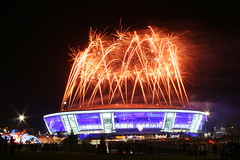
Political and Economic Events around the Grand Opening of the DONBASS ARENA
- Ukraine opens the largest soccer stadium in Eastern Europe – DONBASS ARENA. A new stadium has 50,000 seats. It is the first stadium with a five-star UEFA ELITE rating built in Eastern Europe. Around $400 mln were spent on its construction.
- BEYONCE performed at the DONBASS ARENA opening ceremony. President of FC SHAKTAR (eng. Coal-miner) and member of POR party, Rinat Akhmetov, said that Beyonce received $2 mln for her performance.
- Donbass region demonstrates its support of POR party once again. President Yushchenko got booed at the opening ceremony of DONBASS ARENA. Prime-minister Tymoshenko who was at the opening ceremony refused to make a speech after she saw how the audience "welcomed" President Yushchenko.
Subscribe to:
Posts (Atom)